





A live data platform does not give you a clean modernization boundary. Jobs are still being scheduled, packages are still being loaded, users still expect results, and every change has to coexist with what is already running.
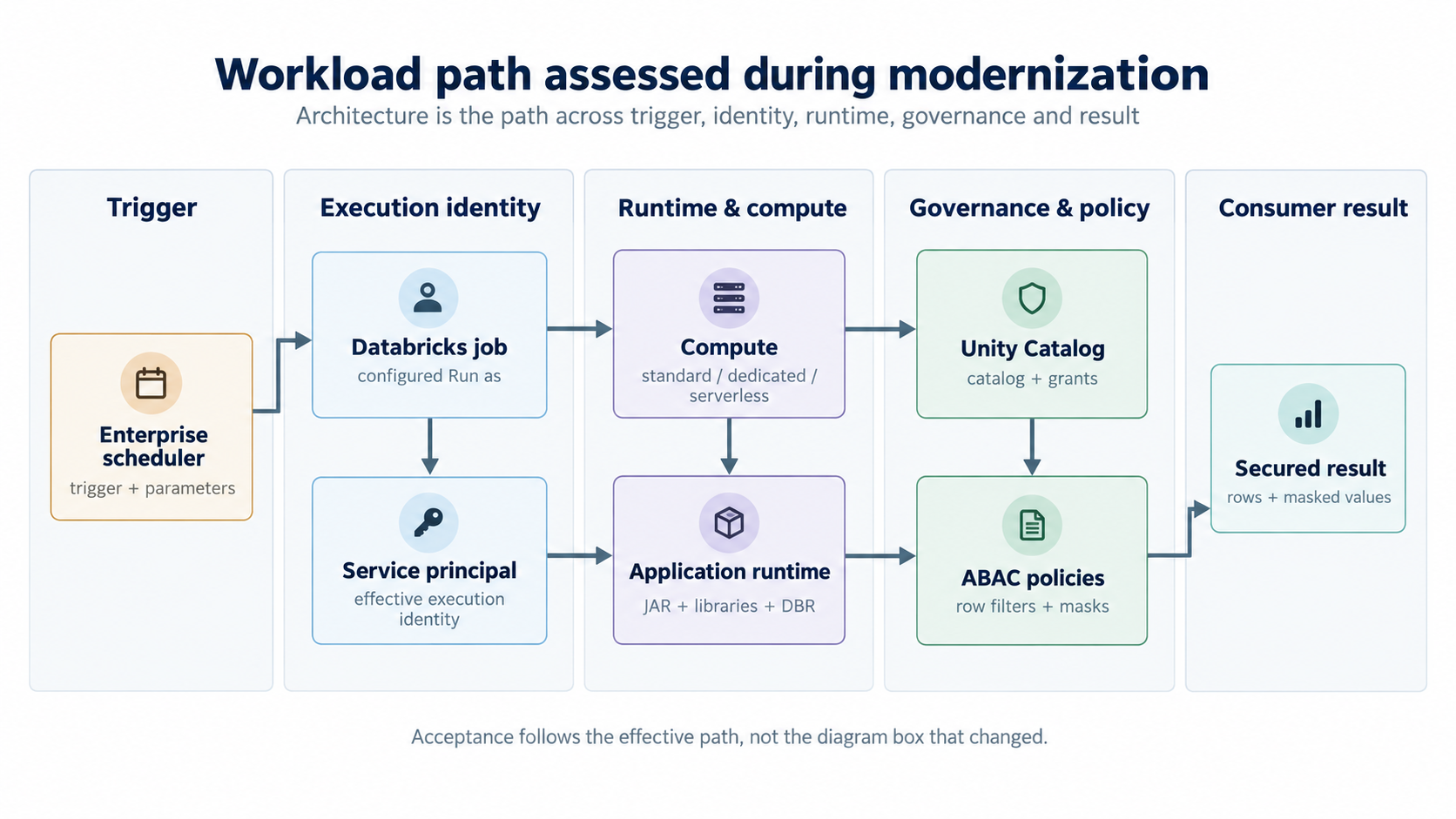
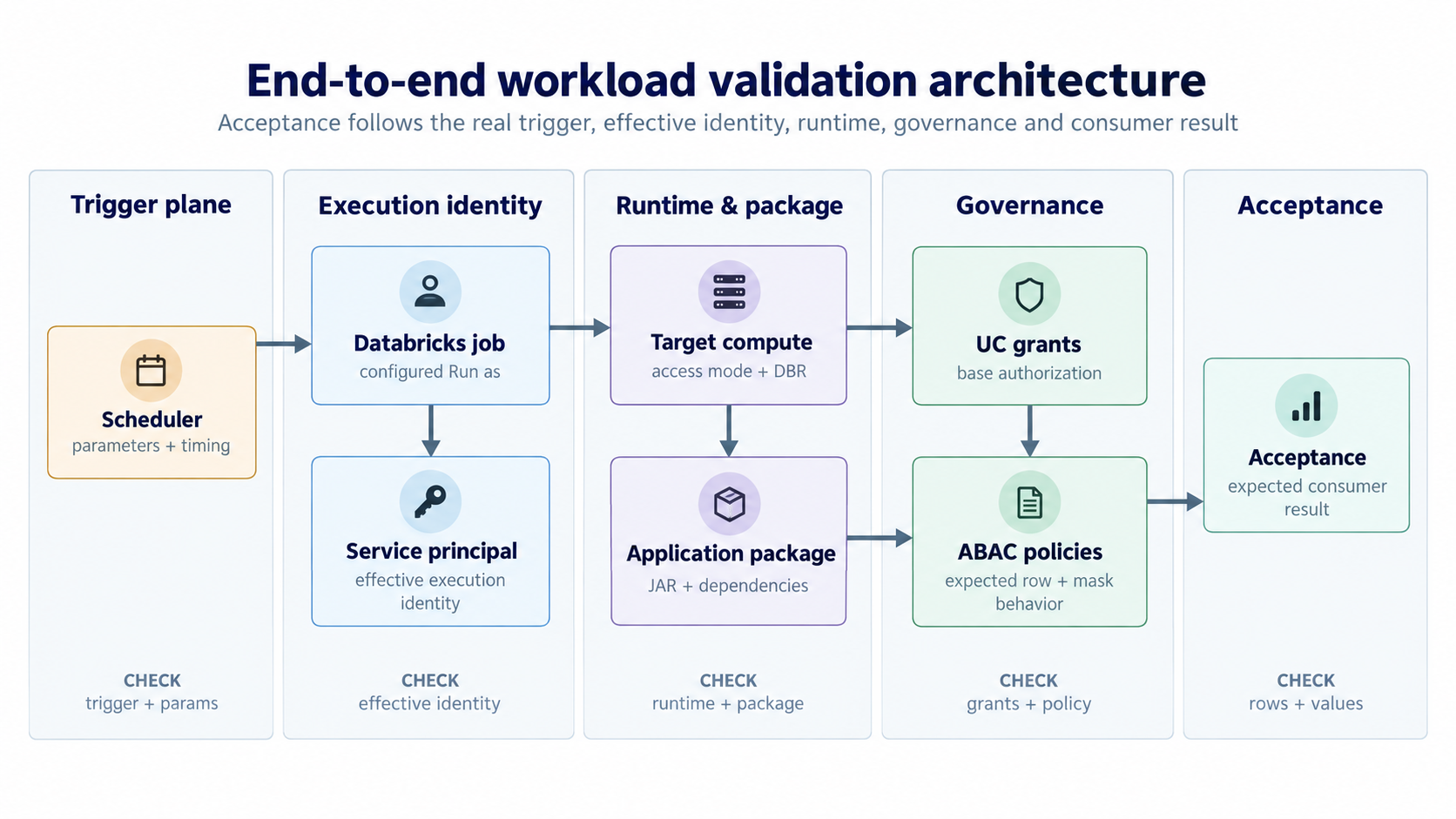
In the estate we were working with, a workload could start in an enterprise scheduler, enter Databricks with a particular set of parameters, run under an identity different from the person who initiated it, load an application package and its libraries, select a compute mode, resolve governed objects, and finally return data shaped by access policy.
Looking at those steps as one path changed the program. A runtime upgrade could expose a library assumption several layers away. A Unity Catalog change could surface an identity problem. An FGAC design could behave correctly in a pilot and still need an operating model before production rollout.
The question we kept returning to was simple: what path does this workload actually follow, and what else depends on that path?
Building the shared assessment
We started with inventory because we needed scale, but inventory alone was too flat. Jobs, tables, repositories, runtimes, libraries, identities, permissions, and scheduler mappings lived in different systems and were maintained for different reasons. Knowing that an object existed did not tell us which trigger invoked it, which package expected it, or which principal eventually reached the data.
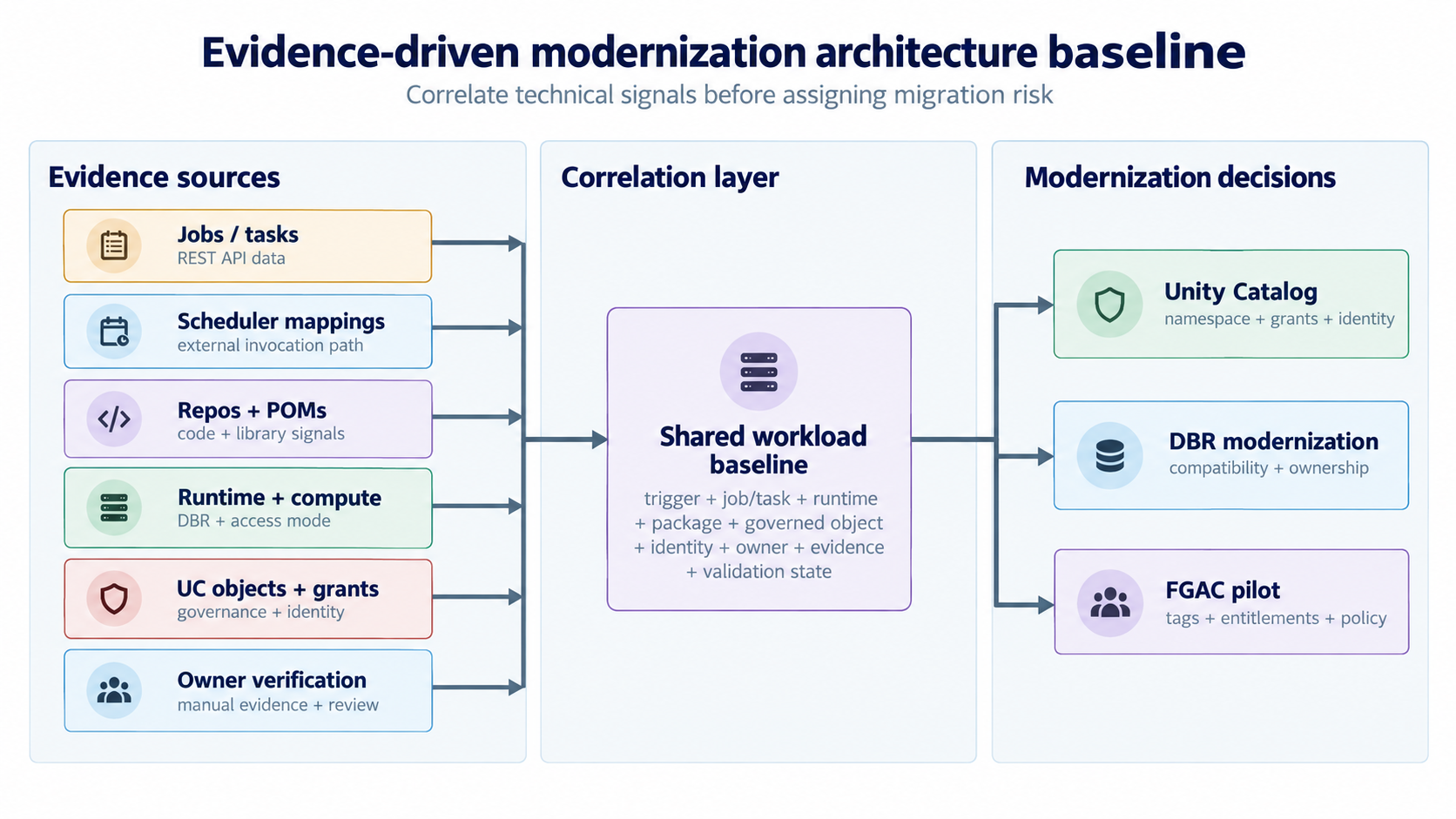
So the assessment became a join across evidence sources. Databricks REST API metadata supplied job, task, compute, and workspace signals. Repository and POM inspection exposed application and library dependencies. Scheduler mappings supplied the external invocation path. Unity Catalog and permission data supplied the access side. Where the restricted environment prevented broad automated discovery, engineers filled the gaps through targeted inspection and owner review.
A working dependency record became more concrete than a generic inventory row: trigger, job or task, runtime and compute, application package, governed object, effective execution identity, downstream consumer, owner, evidence, and validation state. Once findings could be attached to that path, the same baseline supported Unity Catalog migration, Databricks Runtime (DBR) modernization, and fine-grained access control (FGAC) instead of three separate inventories.
The namespace was only the visible change
Fully qualified references often changed from schema.table to catalog.schema.table, making the target catalog explicit. Existing two-part references still needed review because their resolution depended on the current catalog. The namespace was easy to see; the assumptions wrapped around it were not.
Compute was one of those assumptions. Some older custom workloads relied on capabilities that were not a natural fit for standard access mode. RDD-dependent paths, for example, required a dedicated-compute boundary while the surrounding application was modernized. Unity Catalog planning therefore had to move with the workload's code and runtime behavior rather than beside it. [1]
Inventory told us how much existed. Dependency mapping told us what could move together - and what could not. A small shared component could carry more migration risk than a much larger object inventory if several execution paths depended on it.
When a library finding changed the plan
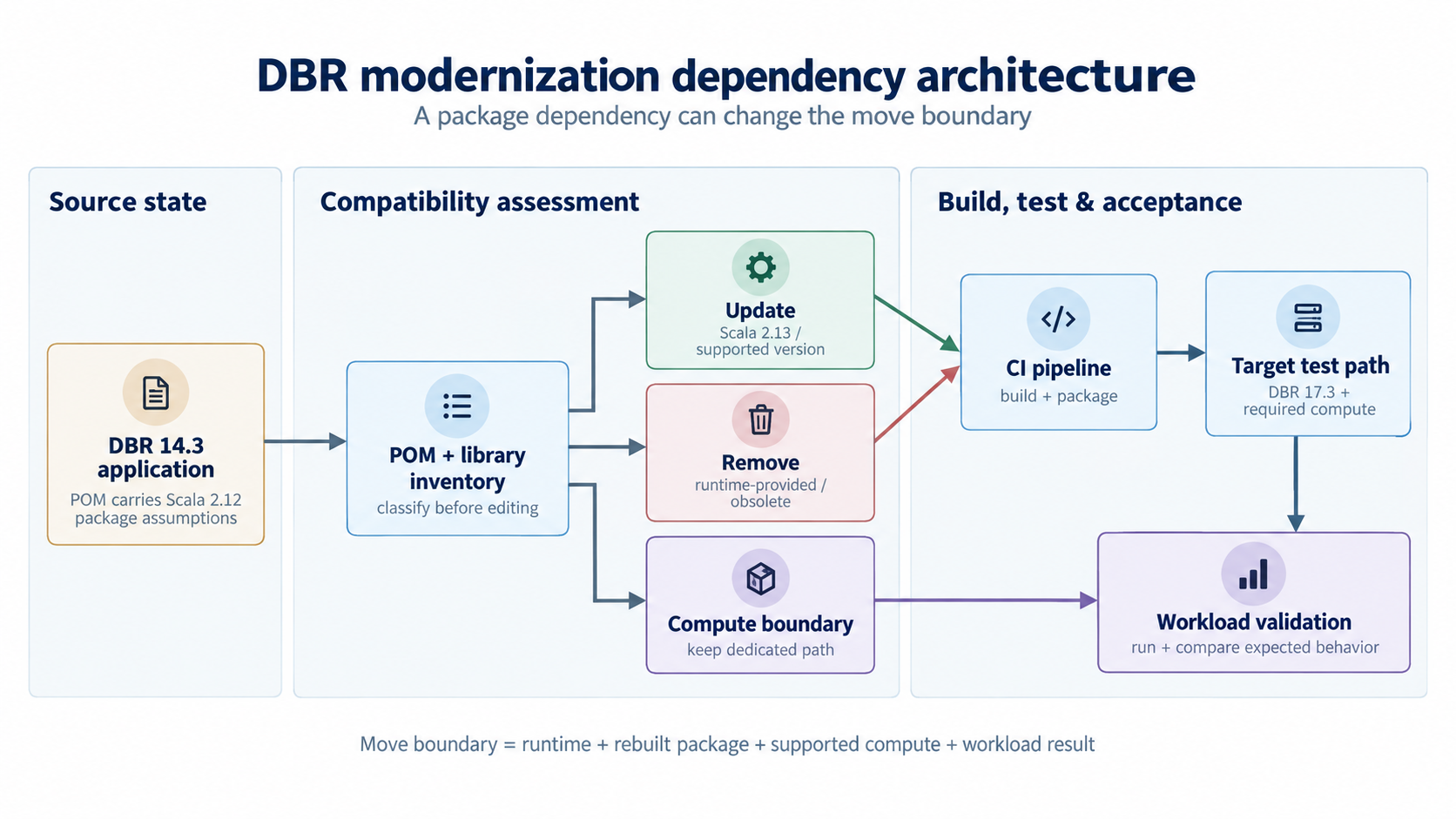
The move from DBR 14.3 LTS toward DBR 17.3 LTS made that dependency problem tangible. Older application POMs contained a mix of Scala 2.12 artifacts, library versions that needed to move, dependencies already provided by the target runtime, and packages that no longer belonged in the build. "Upgrade the libraries" was not one task; it was several different ownership decisions hiding under one label.
A representative compatibility finding changed the move boundary. An application that initially looked like a straightforward runtime move still carried Scala 2.12 package assumptions in its POM. Moving only the runtime would therefore have left the application package on an incompatible dependency line. We classified the package finding separately, moved affected dependencies to Scala 2.13-compatible variants or newer supported versions where required, removed dependencies that the target runtime already provided, and preserved a dedicated-compute boundary for workloads that still required it.
The first result was intentionally narrow and verifiable: the remediated POMs built successfully through the existing CI pipeline, the rebuilt packages were deployed into the target test path, and workload testing continued on DBR 17.3 LTS. That did not prove the runtime program was finished. It proved that what had looked like a generic runtime upgrade had become a repeatable compatibility class with a clear package, compute, and validation boundary.
Testing shared dependencies without widening the blast radius
Single-consumer dependencies were usually straightforward: when the change was understood, an in-place remediation kept the path simple. Shared application and library dependencies were different. Changing the original first would put every consumer into the same test event and make failures harder to isolate.
For those shared cases, we created a separate version of the dependency package and redirected only controlled workload paths to it. That boundary was about the application dependency; it did not imply that tables, jobs, permissions, or policy state had been cloned into an equivalent environment. That package boundary did not, by itself, prove equivalent permissions, tag or policy coverage, output routing, or isolation from production side effects; those remained separate workload-validation checks before the change could widen. We also tracked the legacy scheduler relationships attached to the old path so they could be marked for decommissioning after the replacement path was accepted.
That small distinction changed the review conversation. Instead of asking who might be affected, the team could test a known set of consumers, observe the result, and decide when the change was ready to widen.
We automated repetition, not judgment
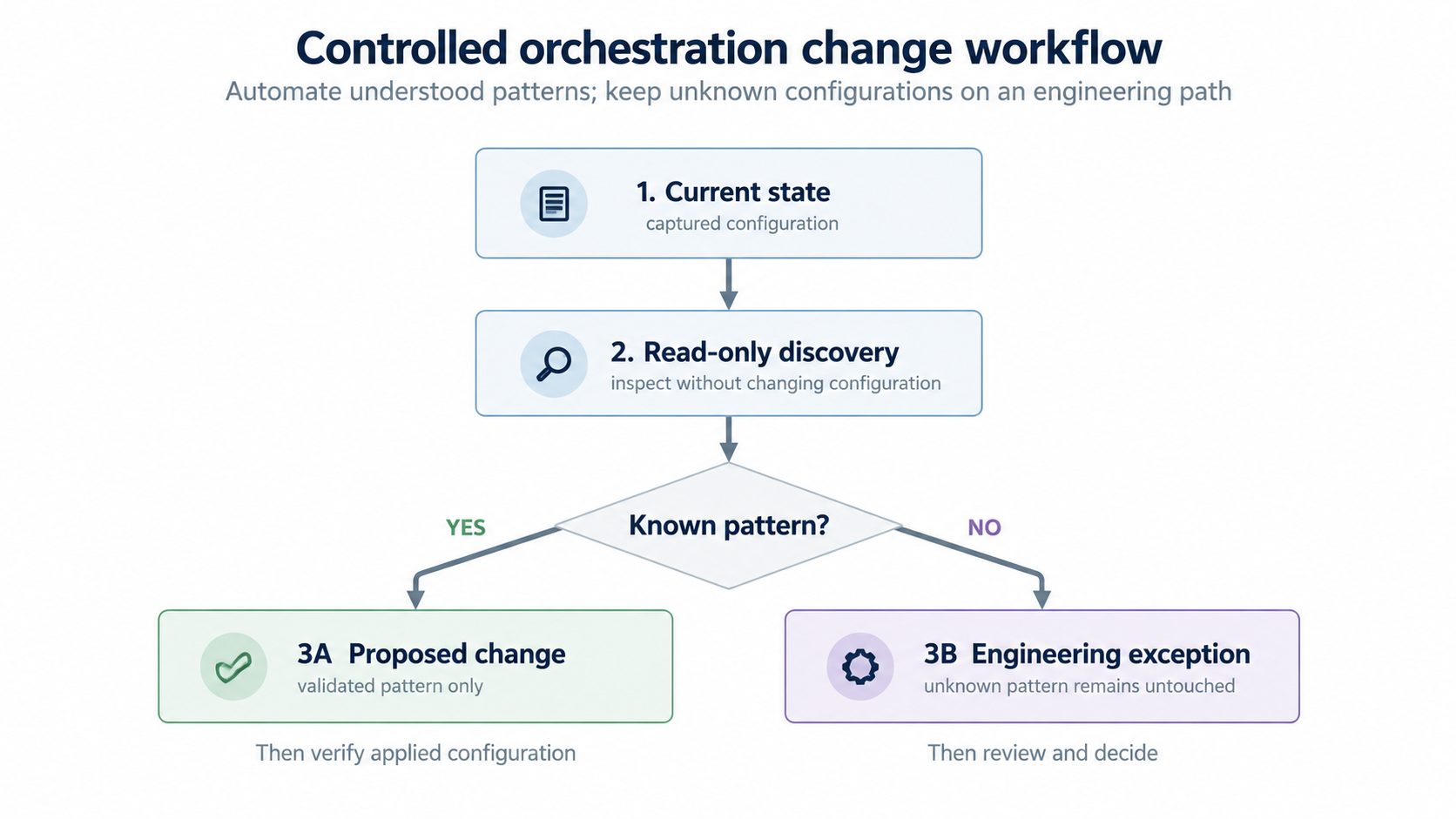
Orchestration was another place where scale could turn a simple edit into a risky manual exercise. We treated configuration as structured engineering input, but the first pass remained read-only. Known patterns could be prepared for change; unknown patterns stayed untouched and went to engineering review.
For accepted updates, we retained the original, proposed, and applied states and made the update logic idempotent. A successful API response only told us that a request had been accepted. Configuration verification came first; workload validation came after it.
Designing FGAC for change, not just for the demo
The FGAC work sat at a different maturity point from the runtime program. The policy model had been designed and exercised through pilot scenarios, while the reusable framework and phased production rollout were still being built. We kept that boundary explicit: a pilot can validate policy behavior without proving the production operating model.
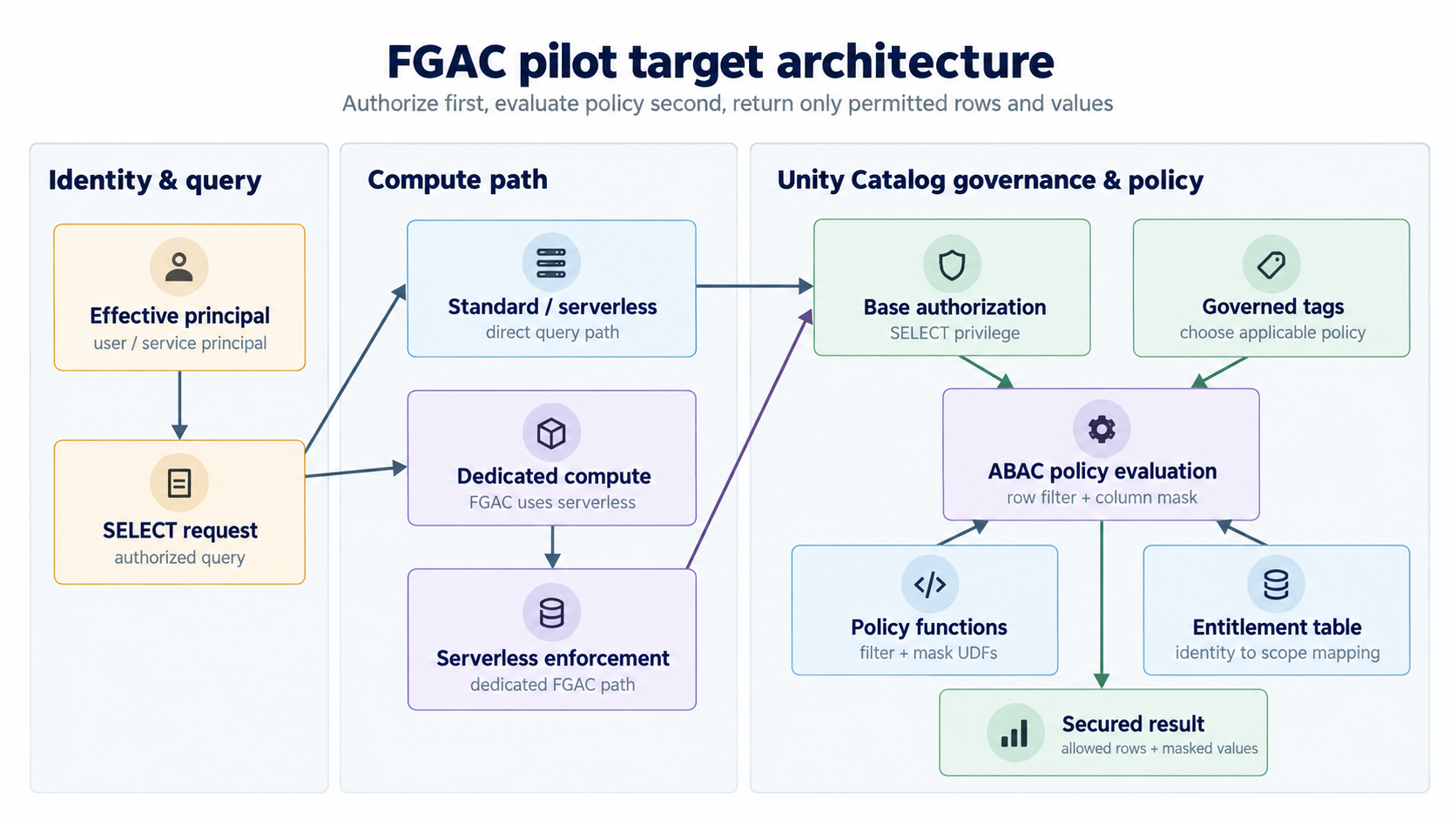
The pilot was designed around Unity Catalog attribute-based access control (ABAC). Governed tags identified where row-filter and column-mask policies should apply, approved identity-to-business-scope mappings lived in a master entitlement table, and policy functions evaluated those mappings at query time. Base SELECT permission remained the first authorization gate; FGAC narrowed what an already-authorized principal could see. [2]
The estate runs on AWS, and representative FGAC paths were exercised on serverless, standard, and dedicated compute. Dedicated-compute testing mattered because fine-grained filtering on that access mode is backed by serverless enforcement. We treated that serverless hop as part of the workload path rather than an implementation detail hidden behind the query. [3] For the ABAC paths described here, the target runtime met the documented compute requirements for standard and dedicated compute. [6]
The claims-domain pilot tested both allowed and restricted outcomes. A persona mapped to one approved business scope was expected to receive only the corresponding rows, while another tagged scope was filtered out. Masking tests separately checked protected values so that an authorized query could still return masked content when the persona was not entitled to the original value. In that claims workload, a successful query alone was not enough: the negative case had to show that rows outside the approved business scope and protected member-level values remained unavailable. Customer identities, business codes, table names, and row counts are intentionally omitted.
As the pilot moves toward production, the policy control surface is being treated as part of governance rather than passive metadata. Changes to governed tags, entitlement mappings, or policy functions can change what an authorized principal sees, so the production framework is being designed around designated governance owners, reviewed change paths, and explicit validation. Ordinary query access does not imply ownership of those control changes. The exact production ownership model is still being finalized as part of the phased rollout.
Execution identity mattered as much as the trigger
Scheduled workloads made one identity distinction impossible to ignore: the principal that starts a workload is not necessarily the principal Databricks uses to read its data. An external enterprise scheduler could trigger a job while the job itself ran under a configured Run as identity.
For production scheduling, we used service principals rather than individual user identities, following Databricks' recommended pattern for production jobs and automated workloads. Each service principal received the workspace and Unity Catalog privileges required by the workload; the consumer's permissions remained a separate concern. Access tests therefore exercised the effective execution principal, not an administrator's interactive session, and the output-serving path was checked separately when another user consumed the result. [4]
Assigning runtime remediation to the right owner
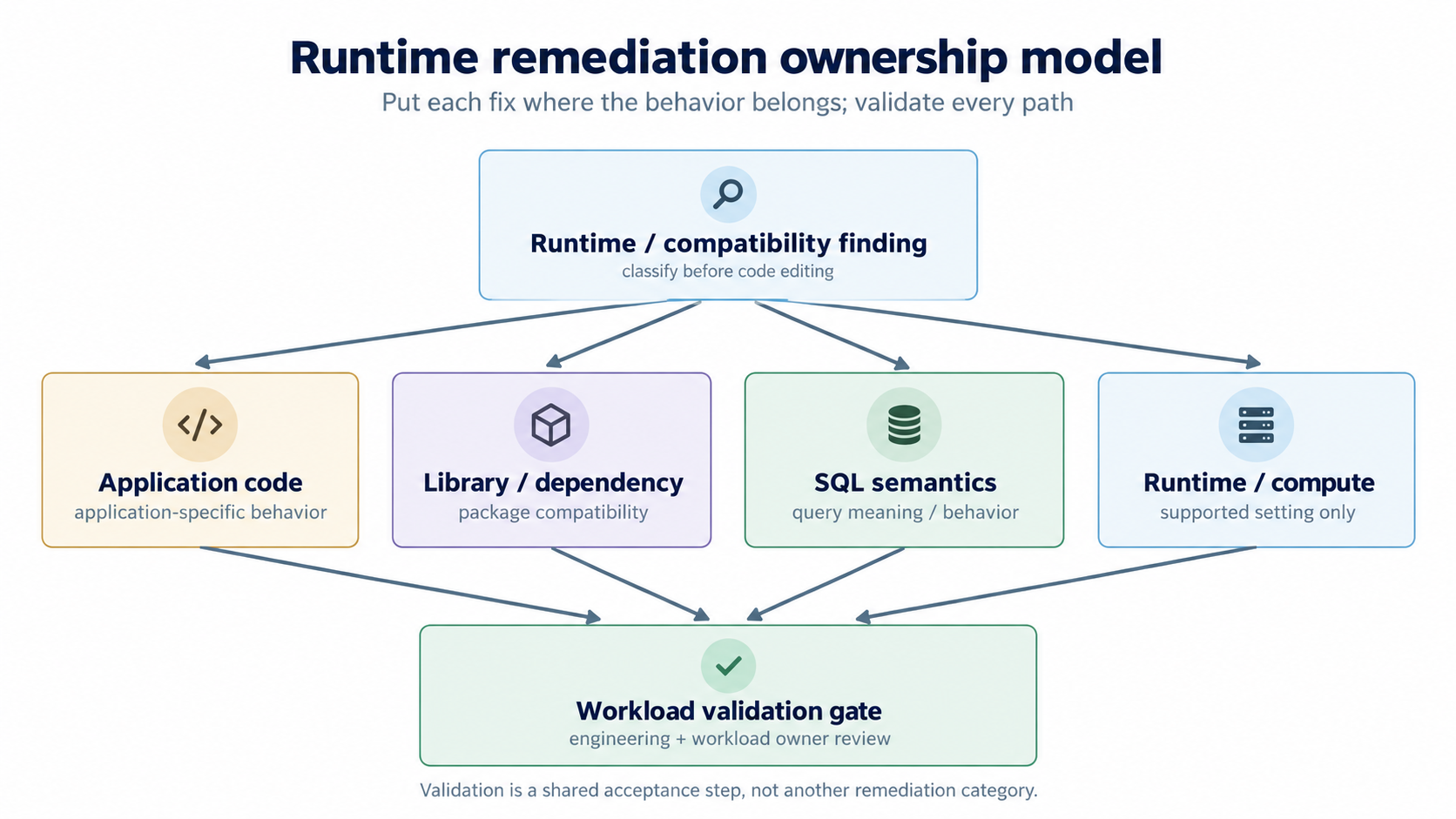
The DBR assessment reinforced another point: not every compatibility finding belongs in source code. Some were application changes; others belonged to libraries, SQL semantics, or supported runtime and compute configuration. The better question was not 'where can we make the quickest fix?' but 'where should this behavior live after modernization?'
The file-metadata example shows why that distinction matters. input_file_name() is unsupported in DBR 17.3 LTS and above, but replacing it blindly with _metadata.file_name can change meaning when the workload actually depends on a full source path. The remediation has to preserve intent: _metadata.file_name is the filename, while _metadata.file_path carries the source path. [5]
We treated configuration with the same restraint. A shared setting can be the right ownership boundary only when the target compute supports it and the setting deliberately preserves the intended behavior. Legacy Spark settings were not a default escape hatch from code remediation. Whatever the owner, the behavior still had to survive execution validation.
Validation had to follow the workload
Validation was where the modernization streams came back together. A job could be completed while the scheduler passed the wrong parameter. A package could be built while the workload still selected an incompatible execution path. A policy definition could be accepted while the effective persona received the wrong row scope. Namespace resolution could succeed while the Run as identity still lacked the required data privilege.
So the final question was not whether each component passed in isolation. It was whether triggers, parameters, effective execution identity, runtime, governance policy, and expected consumer result all aligned on the path the workload would actually use.
What we would carry into the next modernization
1. Inventory gives scale; dependency mapping gives risk. Counts matter, but relationships determine the blast radius.
2. Shared dependencies need an explicit test boundary. Isolate a change before widening it to every consumer.
3. Automate patterns you understand. Unknown configuration should stay visible to an engineer.
4. Put remediation where the behavior should live afterward. Application, dependency, SQL, and supported platform configuration are different ownership boundaries.
5. Validate the workload path. Include the effective execution identity and the expected data result.
The path between the boxes was the architecture
The program is still active. Runtime remediation and workload testing continue, and the FGAC pilot is being turned into a reusable framework for phased production rollout. That is not a caveat to hide in the footnotes; it is part of the engineering story. The most defensible result so far is not 'modernization complete.' It is that problems that once sat in separate workstreams can now be evaluated against the same workload path.
That common path has already produced practical outcomes: repeatable compatibility classes for runtime remediation, application packages that can be rebuilt and moved into testing with clearer ownership, and an FGAC pilot that demonstrated expected allowed and restricted outcomes before the operating model is scaled out. These are bounded results, not a claim that the modernization is complete.
Another runtime will arrive. Access requirements will change. Scheduler relationships will age. The reusable lesson is simple enough to survive all three: understand how a change travels through the workload before changing the platform around it.
Technical references
(Official Databricks documentation referenced for the platform behaviors discussed above; links verified September 2026.)
[1] Dedicated compute overview
[2] Unity Catalog ABAC core concepts
[3] Fine-grained access control on dedicated compute
[4] Lakeflow Jobs identities and Run as privileges
[6] ABAC row-filter and column-mask requirements
[8] Databricks Runtime 17.3 LTS
Editorial note: This article presents implementation lessons from an anonymized healthcare and life sciences Databricks modernization. Customer names, exact estate counts, internal identifiers, proprietary scheduler terminology, security-group names, business codes, and topology details have been intentionally omitted. The runtime modernization and FGAC production rollout described here are ongoing; pilot and test results are not presented as completed production outcomes.